8 Essential Knots Everyone Should Know
Tying down a load, pitching a tarp, hanging a hammock, or joining two ropes: eight knots handle nearly all of it. Each one below says what it's for and how to tie it.
Loops and stoppers
- Bowline: a fixed loop that won't slip. Make a small overhand loop in the standing part. Pass the end up through it, around behind the standing part, and back down through the small loop ("the rabbit comes out of the hole, around the tree, and back down the hole"). Pull tight. It's easy to untie even after a heavy load.

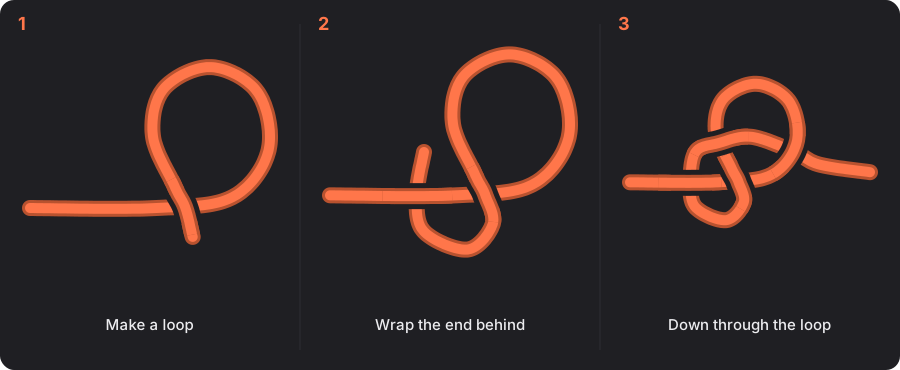
- Figure-eight stopper: keeps a rope from pulling through. Make a loop, pass the end around the standing part, then back down through the loop so it forms an "8". Use it at a rope's end so it can't slip out of a pulley, grommet, or your hand.
Tie to a post, ring, or tree
- Clove hitch: quick and adjustable. Wrap the rope around a post, cross over the first wrap, wrap around again, and tuck the end under the second wrap. Fast for tarps and temporary ties. Back it up with a half hitch if the load shifts.

- Two half hitches: the all-purpose tie-off. Pass the rope around a post or ring, then wrap the end around the standing part and through the loop twice, both times in the same direction. Snug it up. Good for tying a boat or a clothesline.

- Taut-line hitch: adjustable tension. Pass the rope around a stake, then wrap the end twice around the standing part inside the loop, and once more outside those wraps. Slide the knot to tighten or loosen tent and tarp lines.

Tie down a load
- Trucker's hitch: crank it tight. Make a fixed loop partway along the rope, pass the end around a hook or rail, back up through the loop, and pull down hard, since the loop works like a pulley. Lock it with two half hitches. It's the knot for strapping things to a roof rack or truck bed.

Join two ropes
- Sheet bend: joins ropes of different sizes. Make a bight (U-shape) in the thicker rope. Pass the thinner rope up through it, around behind both legs of the bight, and tuck it under itself. Pull tight.

- Square knot: for bundles and bandages. Tie right over left, then left over right, so the knot lies flat. Use it only for low-load jobs like tying a bundle or a bandage. It can slip or spill under heavy load, so never use it to join ropes that carry weight.

Safety note
These knots are for everyday, camping, and household use. Climbing, rescue, rigging, and anything that holds a person's weight need proper training, rated equipment, and knots checked by a qualified instructor.
Quick answer
The most useful everyday knots are the bowline (a fixed loop), the clove hitch and two half hitches (tie to a post), the taut-line hitch (adjustable tent lines), the trucker's hitch (tie down loads), the sheet bend (join ropes), the square knot (bundles), and the figure-eight stopper.